Showing posts with label Christianity. Show all posts

Saturday, September 8, 2012

Dear Mormon Friends, It’s Time to Go “All-In” for Mitt

Below is an open letter penned by two Evangelicals to the LDS Community: 
Nancy and I started Evangelicals for Mitt in 2006 with one simple idea: To enlist the mighty machinery of evangelical activism behind the single best candidate for President of the United States, Mitt Romney. Even then we could see the need for a man of Mitt’s unique talents and now – with labor participation the lowest in 30 years and with the most sluggish recovery since the Great Depression – the need is even greater.
We were more idealistic back in those days. Convinced of Mitt’s merits, we saw our task as relatively easy. Introduce Mitt to evangelicals, deal with the relatively easy questions about theology and politics, and then watch him win social conservatives on his way to the White House. Of course politics is never easy, and there are always competitors for the same set of voters. First Mike Huckabee won enough evangelicals to hand John McCain the nomination in 2008, then Rick Santorum swept southern conservatives and challenged Mitt for the evangelical vote in 2012.
But now, all that is past. Evangelicals are finally united behind Mitt (even 2008 Huckabee supporter – and coolest action star in the universe – Chuck Norris is pleading with evangelicals to vote Barack Obama out of office), and Mitt’s rivaling George Bush’s astounding share of the evangelical vote in 2008. Pro-Obama evangelicals are coming back home to the Republican Party after Obama’s almost four-year assault on religious liberty and his zealous support for abortion. In short, evangelicals – as theologically and culturally divided as we are – will be there for Mitt on election day.
Curiously, however, we’ve heard disturbing reports that LDS Mitt supporters are hanging back just a bit. Some are afraid of stereotyping (“just because I’m Mormon doesn’t mean I’m going to automatically support Mitt. After all, I can’t stand Harry Reid!”), but many more seem just a bit confused about the role of the church in politics. If the LDS church is politically neutral, how can you use your church relationships to mobilize voters and donors?
But let’s back up a moment. Is the LDS church really “neutral?” Is my Presbyterian Church really “neutral?” Yes, I’ve read the portions of the LDS Handbook that emphasize that the church is politically neutral and doesn’t endorse candidates. But the fact that the church is nonpartisan doesn’t mean that it’s neutral on the key moral issues of the day or that the church’s members must maintain their neutrality. In fact, the LDS Handbook specifically urges member involvement:
"Members are encouraged to support measures that strengthen the moral fabric of society, particularly those designed to maintain and strengthen the family as the fundamental unit of society."
Let’s be perfectly clear, after the God-booing abortion celebration masquerading as the Democratic National Convention, the moral choices in this election are beyond stark. Let’s just examine the issue of abortion. In Deuteronomy 30:19, God lays out His will for His people:
“I call heaven and earth to witness against you today, that I have set before you life and death, blessing and curse. Therefore choose life, that you and your offspring may live . . .”
And now here’s the Democratic party platform:
The Democratic Party strongly and unequivocally supports Roe v. Wade and a woman’s right to make decisions regarding her pregnancy, including a safe and legal abortion, regardless of ability to pay. We oppose any and all efforts to weaken or undermine that right.
By contrast, here’s the Republican party platform:
Faithful to the “self-evident” truths enshrined in the Declaration of Independence, we assert the sanctity of human life and affirm that the unborn child has a fundamental individual right to life which cannot be infringed. We support a human life amendment to the Constitution and endorse legislation to make clear that the Fourteenth Amendment’s protections apply to unborn children.
Is there anything that threatens the “moral fabric of society” or the “family as the fundamental unit of society” as much as granting mothers the “right” to order doctors to kill their innocent children in the womb?
In addition, the Obama administration’s assault on religious liberty through the HHS contraception and abortifacient mandates represents a clear and present danger to the autonomy of the church. The administration is telling Americans of every faith that if they leave the walls of their church and attempt to reach out to their communities – either as business owners or through ministries – that they can only do so on the state’s terms while advancing the state’s values. This is antithetical to the First Amendment and antithetical to fundamental American traditions.
In other words, while your church and my church will not endorse any candidate for president, that does not mean that individual congregants cannot or should not use our web of church friendships and relationships to invest fully in the outcome of this election.
In the six years that Nancy and I have run Evangelicals for Mitt, we’ve made a huge number of Mormon friends and learned a great deal from the LDS church. In fact, we’ve taken flack for urging evangelicals to emulate Mormons in your approach to missions, service, and church growth. We have long stood on the barricades against anti-Mormon bigots. But now we’re asking you to take a page from the evangelical book: Engage fully, proudly, and without hesitation.
Call your friends from your ward. Make sure they’re registered to vote. Ask them if they’ve given to Mitt’s campaign. If they need more education on the issues, equip them with materials. Don’t use church resources; use your own. Between worship and Sunday School, I can’t tell you how many conversations Nancy and I have had about Mitt, about abortion, about religious liberty, and – yes – about the economy. Politics isn’t a “dirty business;” it’s part of our life and obligations as citizens of a nation and government “of the people, by the people, for the people.”
Now is not the time for concerns about stereotyping, for false worries about “neutrality.” The church will remain nonpartisan, but you don’t have to. There are more than six million Mormons in America, and the causes of life and religious liberty need every one.
It’s time to go “all-in” for Mitt.
By David and Nancy French (EVANGELICALS for MITT)

Sunday, December 4, 2011

The LDS Church Launches New Website Focusing On The Bible

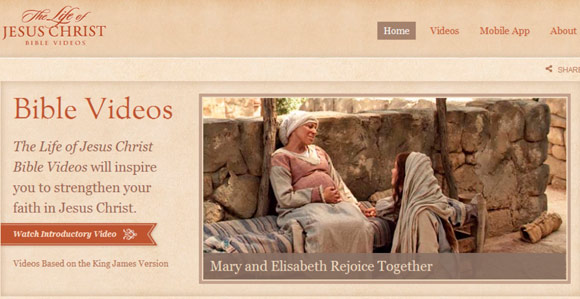
The LDS Church has just announced during tonight's December 4th Christmas Broadcast that has launched a new website consisting of Bible videos for viewers to watch. The LDS Newsroom has more information about this new website: 
BibleVideos.lds.org is a repository for original short videos that depict scenes from Christ’s life, ranging from the angel foretelling Christ’s birth to the Savior's Resurrection.
President Henry B. Eyring, First Counselor in the First Presidency, announced the site during his talk at the devotional.
“Like the scriptures which these short films follow faithfully they may seem to you quiet,” he said. “Your faith and the Holy Ghost will create the emotion these world-changing events deserve.”
As reported from the LDS Newsroom, The Church will be releasing more videos in the future for people of all faiths to enjoy:   
The project will yield more than 100 vignettes portraying the life of Christ, taken directly from the text of the King James Version of the Bible. Over time, each video will be posted to BibleVideos.lds.org along with the scriptural text from which it is taken. The goal is to share the gospel of Jesus Christ by assembling one of the finest collections of Bible videos in the world.
“We intend for these videos to be used freely by individuals, families, and groups,” said Elder Lynn G. Robbins, Executive Director of the Media Services Department. “We want to help our own members strengthen their faith in Jesus Christ, and we offer this freely to other churches who may wish to use these videos in a similar way. The message of the Lord Jesus Christ needs to be shared as widely as possible throughout the world.”
Subscription options, including RSS and e-mail, are available in the footer of the website for users to receive updates when new videos are provided.
The Life of Jesus Christ Bible Videos website is intended to provide members and their families with a new and meaningful way to learn about and share the teachings of Jesus Christ. Through these videos, individuals can explore biblical environments, watch scripture-based stories come to life, view slideshows, and discover additional insights into biblical accounts.
“It is our hope that these New Testament videos will help people to visualize what they have only been able to imagine, and to more deeply feel the truths of the New Testament as they witness the Savior’s life and not just as they read about it,” Elder Robbins said. “Hopefully, there will be entirely new insights into the Savior’s character that will help viewers feel of His love and inspire them to want to be more like Him.”
The website enables individual to share the content in order to extend the videos’ reach and impact. Items on the website can be shared through Facebook, Google+, and Twitter.
“You can give a great and wonderful Christmas if you will remember the gifts God has given you, and as best you can, offer them to others as He would,” President Eyring stated.
The website has a mobile-friendly design and is available in English (biblevideos.lds.org), Spanish (videosdelabiblia.org), and Portuguese (videosbiblicos.org). A free iPad app will also be available in the future, offering a new way to experience Bible stories through sight, sound, and touch.
Given that members of the LDS Church are very active in reading the Bible and have a strong knowledge about Christianity, this will be a resource that will be enjoyed by all Mormons as well as Christians of other denominations.

Sunday, March 13, 2011

Evangelical Christian Realizes Mormons Are Christians After Attending Insitutite

One of the most fascinating stories I have come across on the internet is an interview with an Evangelical named "David" who attended the LDS Institute for four years while working on obtaining a PhD in Molecular Biology. 
I'd like to share a portion of that interview with you (and I encourage you to read the entire interview at the link above) in which he discusses how Institute helped him see that Mormons really are Christians:
"How has your interaction changed your views of Mormons and Mormonism?
At the same time I started attending Institute classes, I made a point to read several books on Mormonism written from conservative evangelical perspectives or by individuals who had left the LDS Church.  Those texts reinforced many of my early LDS preconceptions and argued adamantly that Mormons were not Christians.  I believed as I read those books that I was preparing to enter a mission field, and during the first couple years of attending LDS classes and conversing with Mormons, proselytizing was always at the back of mind.  I couldn't envision Mormons receiving an evangelical version of salvation without first accepting conventional Christian doctrine.   My current perception of Mormonism is quite different.  As I befriended more Mormons, I discovered that some of the most contentious issues that were the focus of anti-Mormon literature were simply irrelevant or ancillary to modern LDS beliefs and practices.   The practical application of their faith and understanding in LDS doctrine was actually similar to that of other Christians with respect to purely biblical doctrine.  Consequently, I no longer believe I am in a position to say the biblical salvation of Mormons is more in question than members of other Christian denominations.   My current practice, which has contributed to the most productive and meaningful of my inter-faith relationships, is to treat Mormons as Christian brothers and sisters as opposed to members of a non-Christian cult.  
I was recently given a book by Stephen E. Robinson that makes several compelling arguments in favor of Mormons being Christians.  I'm in agreement with him on many of his arguments, so I will limit the explanation of my change in heart and mind to one simple conclusion.  To deny someone who accepts the atoning sacrifice of Jesus Christ the title of Christian is to deny the sufficiency of that sacrifice, as you surely can't be saved by grace through Christ and not be a Christian.  I no longer argue, as I once did, that a precondition for that salvation is a proper understanding of its heavenly manifestation and the sufficiency of the grace that makes it possible.  I still disagree with LDS doctrine as it pertains to grace, works and exaltation, but denying salvation to Mormons on those grounds requires passing judgment on the motive of their works.   As a Christian and a witness to many apparently humble acts of Mormon service, I'm personally reluctant to pass judgment.
Evangelical Christians sometimes acknowledge the promptings or the perceived presence of the Holy Spirit in their life, and I specifically remember attending a large LDS social event during the first year of my studies where I really felt the absence of the Holy Spirit.  I never mentioned this feeling to any of my Mormon friends, but I share it now as an example of a subjective experience that I used to substantiate my academic rationale at the time for why Mormons should not be considered Christian.  It's also relevant in that my current acceptance of Mormons as fellow Christians is the result of both intellectual argument and the accumulative effect of more recent subjective experiences.  Shortly before my graduation from the LDS Institute, I was invited to attend a Mormon baptism, at which a moving testimony was given by the LDS friend of the woman being baptized.  I could not have denied the profound influence of the Holy Spirit in that woman's life or in the lives of others who shared their testimony at an LDS church service I attended on a different occasion.  The Spirit could also be felt in many of the prayers offered at Institute gatherings.  Such spiritual fellowship is common amongst Christian brothers and sisters and I can't deny the significance of experiencing it amongst Mormons."
While David acknowledges that he still has doctrinal disagreements with the doctrines of the LDS Church, he at least sees that we are Christians.
David's statement that Mormons are Christians because "to deny someone who accepts the atoning sacrifice of Jesus Christ the title of Christian is to deny the sufficiency of that sacrifice, as you surely can't be saved by grace through Christ and not be a Christian" applies equally to all other denominations who accept the atoning sacrifice of Christ. 
Christians will always have doctrinal disagreements with one another, but its time to put an end to the debate over who is a Christian and who isn't. No one except Christ is in a position to determine who is a Christian and who isn't.

Tuesday, September 28, 2010

Study Finds Mormons Know The Most About Christianity

A recent study conducted by the Pew Forum on Religion & Public Life tested to see how much Americans know about their own religion and the religion of others. They asked thirty two questions that tested a wide range religious subjects such as famous historical religious people, core tenets of different faiths and how much people understood the Bible. What the Pew Forum found is good news for members of the Church of Jesus Christ of Latter Day Saints. 
In terms of overall knowledge about religion, Mormons come in third while Jews come in second place and agnostics as well as atheists come in first place.
However, the most surprising part of this study is how well members of the LDS faith knew about Christianity in comparison to other Christian faiths. Mormons scored the highest when it came to answering questions about Christianity and the Bible by getting 7.9 out of 12 right on average. Stephen Prothero, a professor of religion at Boston University and an advisor on the survey made this comment about how well Mormons know about the Bible: 
"He said he found it significant that Mormons, who are not considered Christians by many fundamentalists, showed greater knowledge of the Bible than evangelical Christians."
It is good to know that Mormons, who claim to be part of the Christian faith, have the highest knowledge about the Christian tradition. I think the significance of this finding is that Mormons do take the label "Christian" very seriously and that we really are dedicated to the Bible. When we say we're Christians, we mean it. And studies back it up. In fact, as I pointed out in earlier blog posting, there was a study conducted in 2001 by the The Barna Group, a pro-Christian research firm found that Mormons are more likely to read the Bible during the week than are Protestants or Catholics. These studies, as well as other studies, show that Mormons score high on every measure of Christianity whether its Church attendance, knowledge of the Bible, how often we read the Bible and our belief in God and His Son. At some point, Christians of other faiths must realize that we really are Christians despite the doctrinal disagreements we may have.
The Pew Form study found that members of The Church of Jesus Christ of Latter Day Saints take the study of our own religion very seriously. What the study found that Mormons, out of the different faiths involved in this research, are the most dedicated to learning about their own faith.
"Mormons, black Protestants and white evangelicals are the most frequent readers of materials about religion. Fully half of all Mormons (51%) and roughly three-in-ten white evangelicals (30%) and black Protestants (29%) report that they read books or go online to learn about their own religion at least once a week. Only a small fraction of all religiously affiliated Americans – 6% of the general public and no more than 8% of any religious group – say they read books (other than Scripture) or visit websites to learn about religions other than their own at least once a week.
Nearly half of Americans who are affiliated with a religion (48%) say they “seldom” or “never” read books (other than Scripture) or visit websites about their own religion, and 70% say they seldom or never read books or visit websites about other religions."
I think this also ties in with why Mormons are so knowledgeable about our faith and why we score so well on questions about Christianity. Not only are we encouraged to read our scriptures daily, but we are encourage to engage in personal study in reading the words of our religious leaders and reading up on Church history as well as doctrine. That includes comparative studies as we learn about other Christian faiths in conjunction with learning about our own. 
The study revealed some clues about what made people more knowledgeable about other people's faiths. They found that education was the greatest factor in influencing how much a person know about religion. The Pew Forum also found that religious activity was also a significant factor: 
"Other factors linked with religious knowledge include reading Scripture at least once a week and talking about religion with friends and family. People who say they frequently talk about religion with friends and family get an average of roughly two more questions right than those who say they rarely or never discuss religion. People with the highest levels of religious commitment – those who say that they attend worship services at least once a week and that religion is very important in their lives – generally demonstrate higher levels of religious knowledge than those with medium or low religious commitment. Having regularly attended religious education classes or participated in a youth group as a child adds more than two questions to the average number answered correctly, compared with those who seldom or never participated in such activities." 
The conclusion I draw from this is that The LDS Church does a great job in helping is members be religiously literate and knowledgeable about religion whether it be our own faith or the faith of others. The emphasis on getting  an education and   participating in Church activities such as attending Sunday services, going to the temple, serving full time missions, having Family Home Evening, personal and family scripture study, going to early morning seminary, and institute all contribute to helping us enrich our religious life on a personal level. It helps us improve spiritually and intellectually. 
What are your thoughts on this study? 

UPDATE 9.29.10: I fixed some links and added a quote for this blog story.